SAGA with Manu S Pillai: How ARPO Is Changing the Way We Understand Kerala's History
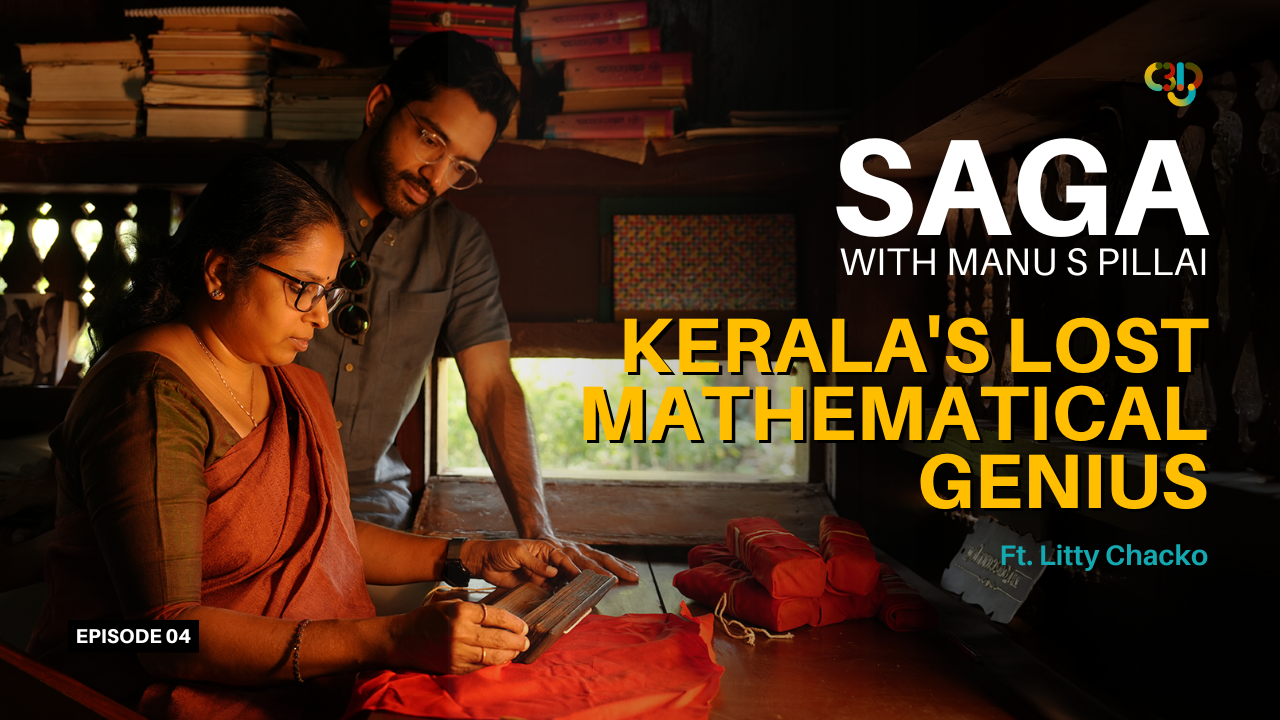
There is a moment in Episode 4 of SAGA that is difficult to forget. Litty Chacko, a Malayalam teacher who spent decades studying the life of a 14th-century mathematician, is sitting in an autorickshaw on the way back from an antique dealer in Kerala. She reads through some crumbling palm leaves she has just bought. And there, in her hands, is the missing seventh chapter of an important manuscript she had been searching for since 2009.
She sat down and cried.
That moment is why this series exists. Many stories of history and culture in Kerala aren’t being told enough. There are mathematicians whose names belong alongside Newton's, ritual performers keeping centuries-old traditions alive on their own, mosques that look like temples and princes who became communists. And SAGA dives into these stories.
What is SAGA?
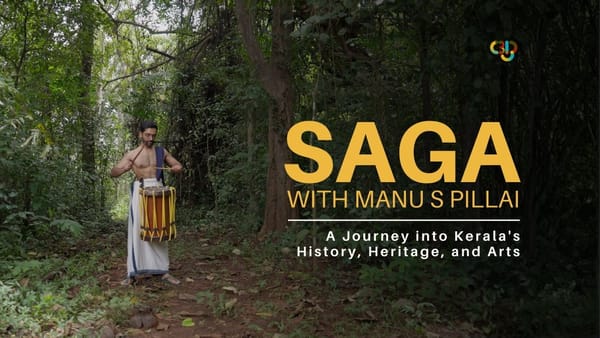
SAGA is a video series produced by ARPO and hosted by Manu S Pillai; historian, author, and one of the most important voices writing about Indian history today.
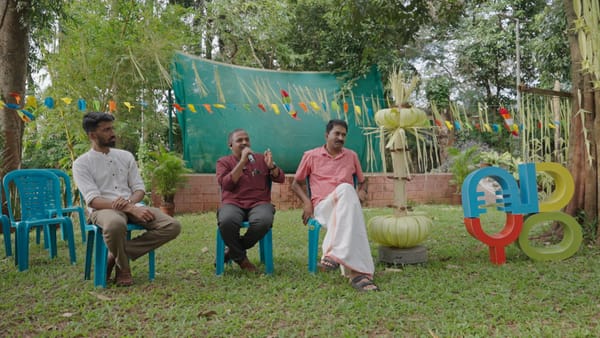
Each episode of ARPO’s SAGA series brings Manu into conversation with a practitioner, scholar, or community member; someone who carries a piece of Kerala's history in their art, music, their craft, and their daily life. The conversations move between the personal and the historical, between the cultural and the political, between what we think we know and what we don't know about cultural heritage in Kerala yet.
We launched the SAGA series in November 2025. Five episodes are already out and each one has already opened a conversation that Malayalam cultural discourse had not quite had before.
SAGA’s Impact
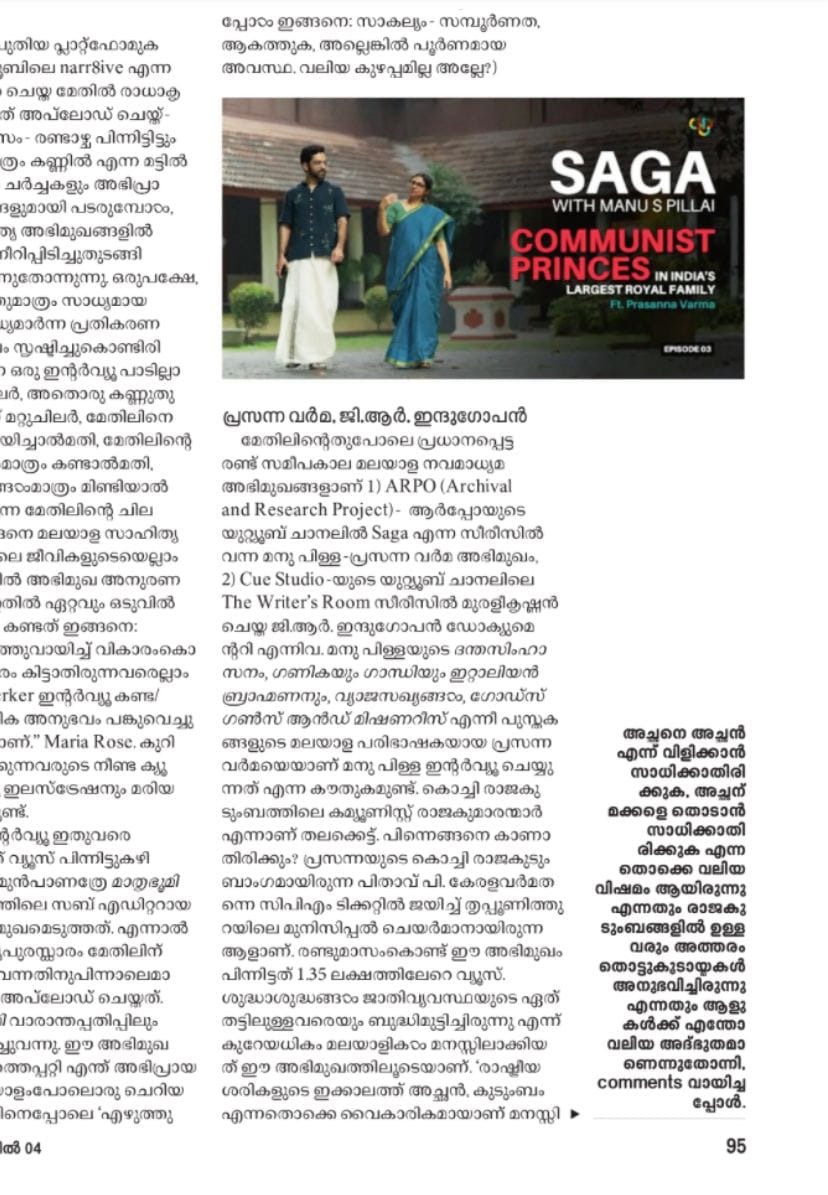
When Mathrubumi Weekly, Malayalam's most respected literary magazine listed the most important conversations in the Malayalam new media space, the SAGA series was named.
Episode 3, the conversation between Manu S Pillai and Prasanna Varma about the communist princes of the Cochin royal family, was singled out as one of the most significant cultural conversations to have happened in new media space. In
Episode 4, SAGA brought the largely forgotten legacy of Sangamagrama Madhava; the brilliant 14th-century mathematician from Kerala into public conversation.
The Kerala government recently established a dedicated institute honouring Sangamagrama Madhava, the 14th-century Kerala mathematician whose work preceded Newton and Leibniz by two centuries, a name SAGA Episode 4 had just reintroduced to many. Litty Chacko, the Malayalam teacher who spent decades recovering Madhava's work, won the Devi Award, signed a book deal and gained access to many manuscript collections that will considerably help her research. A philanthropist who watched Sreejith Sarma, one of only four or five Theeyattu practitioners left in Kerala, perform on screen, committed one lakh rupees toward his work.
I had no idea that one of the most brilliant mathematicians in the world is from a small village near my home in Kerala. Saw this on news, and just watched the SAGA episode by ARPO where @UnamPillai chats with Litty Chacko to talk about Sangamagrama Madhava! pic.twitter.com/ORNw7w6YSm
— Angelin Joy (@AngelinJ45780) April 6, 2026
SAGA So Far
Ep 1: Exploring Chenda ft. Deepu Menon
The first episode begins with an exploration of a sound almost every Malayali has heard: the chenda. Chenda is one of Kerala's most iconic percussion instruments, present at temple festivals, political processions, weddings, and celebrations for centuries.
Deepu Menon is a young chenda artist navigating what it means to carry a traditional art form into the 21st century with changing audiences, evolving performance spaces, the economics of being a classical musician in a world that streams everything for free. Manu's conversation with him moves through discipline and training and ends with something almost no cultural documentary bothers to include: an actual lesson. The viewer watches Deepu teach Manu the basics of the chenda; the rhythm, the physical difficulty, the sheer embodied knowledge involved tells you more about what it means to be a chenda artist than any narration could.
Ep 2: Kerala Islam and Mappila Culture ft. Dr Ajmal Mueen
The second episode travels to Kozhikode and the Mishkal Mosque, one of the most extraordinary examples of Kerala's syncretic architectural tradition, a wooden mosque built in a style of Kerala's temple architecture. Scholar Dr Ajmal Mueen joins Manu to unpack what the mosque represents: the history of the Mappila community, the layered relationship between faith and trade and architecture, and the very contemporary question of what heritage conservation means for a Muslim community navigating its identity in today's India.
The episode ends on a question that the mosque itself seems to ask: what happens to a layered, syncretic culture when the world around it is pressing it to become simpler?
Ep 3: Communist Princes in Cochin Royal Family ft. Prasanna Varma
The third episode, the one that earned SAGA its recognition in Mathrubumi Weekly, is perhaps its most extraordinary. This series explores the Cochin royal family: a dynasty where princes became communists, princesses spun khadi at Gandhi's call, and matriliny shaped domestic worlds of unexpected intimacy and complexity.
Prasanna Varma, a literary translator whose father and husband both belong to the Cochin royal family, joins Manu for a conversation that moves between personal anecdote and historical analysis with a fluency that is genuinely rare. The episode dismantles several things simultaneously: our assumptions about royalty, our assumptions about communism, our assumptions about Kerala's progressive politics and where they actually came from. It is the kind of conversation that makes you want to call someone and say: did you know this?
Ep 4: Sangamagrama Madhava ft. Litty Chacko
Litty Chacko is a Malayalam teacher who spent decades tracking the life and work of Sangamagrama Madhava, a 14th-century mathematician from Kerala whose work on infinite series preceded Newton and Leibniz by two centuries. The conversation covers how Madhava recorded his mathematical findings as Sanskrit poetry, encoding numbers into verse, so that a line about merchants on a morning journey is simultaneously a precise formula. Litty came to this as a language teacher rather than a mathematician and that turned out to be exactly the right way to approach Madhava’s history.
The episode's best moment is almost novelistic. In 2018, sitting in an autorickshaw on the way back from an antique dealer, Litty leafed through some crumbling palm leaves she had just bought and found the missing seventh chapter of a Madhava text she had been searching for since 2009. She sat down and cried. The episode ends on a question that’s difficult to answer: why does a mathematician whose name now sits alongside Newton's remain largely unknown in his own state?
Ep 5: Theeyattu ft. Sasidhara Sarma & Sreejith Sarma
Episode 5 is a conversation with Sreejith, a 37-year-old Theeyattu performer and his father, a retired bus conductor about the ritual art form of Theeyattu. A Kerala tradition in which a performer embodies the goddess Bhadrakali through an elaborate sequence of kalam painting, costume, mantra, and dance. Sreejith owns a houseboat business specifically because it frees his evenings for performances. He is, by his own account, the youngest person currently performing the Theeyattu regularly and one of only four or five practitioners left.
The conversation holds two timelines together: the father's, who walked ten kilometres to temples after sixteen-hour shifts as a bus conductor, carrying his drum and headgear on a bicycle; and the son's, who performs up to 250 Theeyattus a year while adapting the tradition's aesthetics for an audience that live-streams everything. Demand is growing. Practitioners are vanishing. Sreejith describes burn marks from hot oil and lime paste that blister the skin and performing the next ceremony anyway. The episode doesn't frame this as heroism. It simply shows what it costs to keep something alive.
Ep 6: Ammachis of Travancore ft. Sharat Sunder Rajeev
Most people who know anything about the Travancore royal family know it through the Maharajahs and their deep association with the Sri Padmanabhaswamy Temple. What is less known is how unusual their system of succession was. A Maharajah could not be succeeded by his own son. The queen was not his wife but his sister. And so history followed the line of power; the royal sisters, the Ranis while the wives of the Maharajahs, the Ammachis, and their children, the Tampis, quietly faded from the record.
Episode 6 asks what was lost in that fading. Manu S Pillai sits down with Sharat Sunder Rajeev to recover the world of the Ammachis- who they were, how they lived, and what their erasure from Travancore's history tells us about whose stories get kept and whose get left behind.
Kerala's history is richer, and more alive than most of us have been told. SAGA is the proof and it is only getting started. New episodes are in production. Watch the series on ARPO's YouTube channel and at arpo.in.!